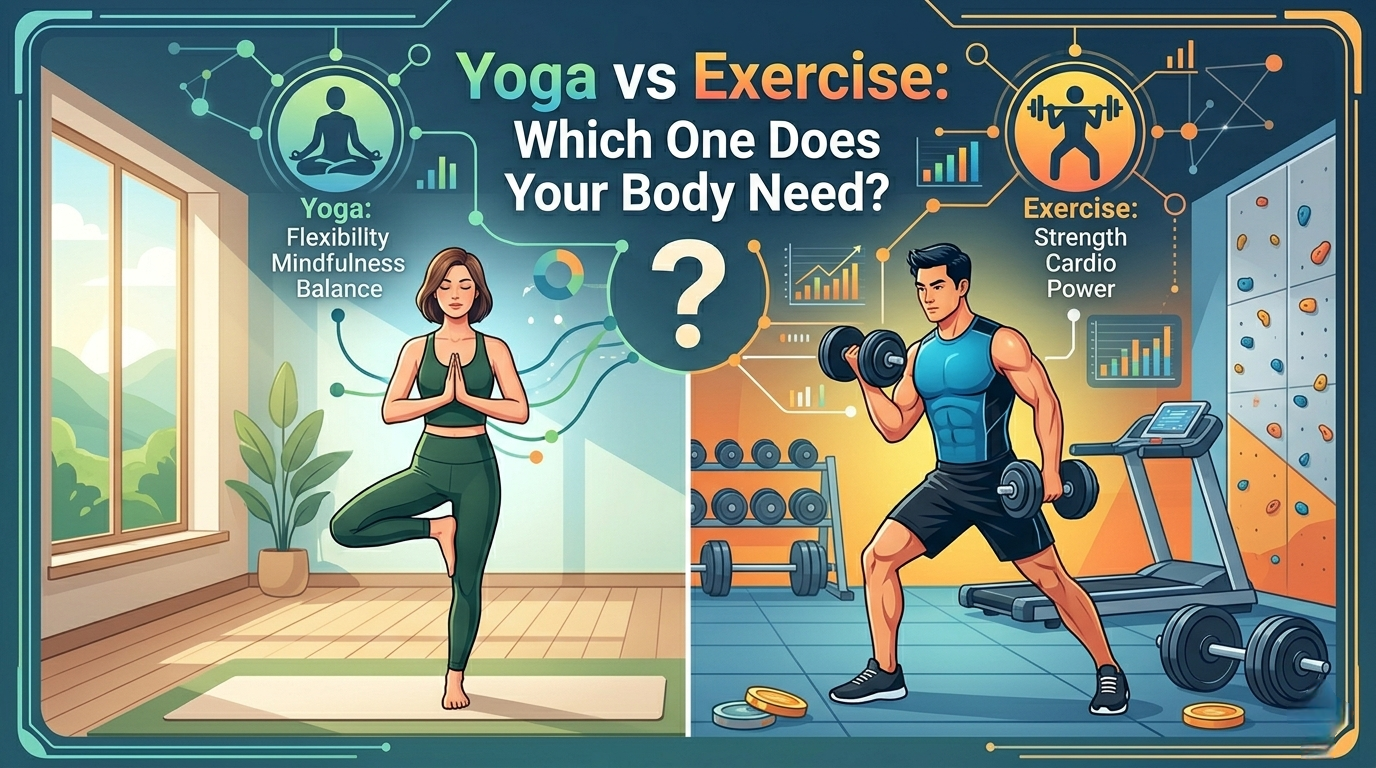
When most people think of “exercise,” they picture heavy weights, running on a treadmill, and dripping with sweat. When those same people think of “yoga,” they often imagine slow stretching, incense, and quiet meditation. This has created a long-standing debate: if you only have an hour a day, should you hit the gym or unroll a yoga mat?
The common misconception is that exercise is for “hard” results (like muscle and cardio) and yoga is for “soft” results (like flexibility and relaxation). This narrow view makes it seem like you have to choose between being strong or being flexible.
So, in the battle of yoga vs exercise, which one does your body actually need?
In this blog, we’ll break down exactly how these two forms of movement affect your heart, your muscles, and your brain so you can decide how to balance them for your best self.
Yoga vs Exercise: Understanding Strength and Flexibility
When we look at the physical body, the debate of yoga vs exercise often comes down to how we build our muscles and move our joints. While both will make you stronger, they use very different movements to get you there.
Traditional Exercise: Building Power from the Outside In
Most traditional exercise, like lifting weights, HIIT, or running, focuses on isotonic movements. This is a fancy way of saying your muscles get shorter and longer as they move a weight (like a bicep curl).
- The Goal: To increase muscle mass, explosive power, and cardiovascular endurance (heart health).
- The Process: Exercise often works by creating tiny “micro-tears” in your muscle fibers. When your body repairs these tears, the muscle grows back bigger and stronger. This is excellent for changing your physical shape and building raw strength.
Yoga: Building Functional Strength from the Inside Out
Yoga takes a different approach by focusing on isometric holds and eccentric stretching. Instead of moving a heavy weight up and down, you use your own body weight and hold a steady position (like a Plank or a Warrior pose).
- The Goal: To build “functional strength”, the kind of strength that helps you lift a heavy grocery bag, climb stairs, or sit with good posture without getting tired.
- The Process: Yoga focuses on joint mobility and “lengthening” the muscles. Instead of just making a muscle bigger, yoga teaches all your muscles to work together as a single, balanced unit. This creates a body that is lean, agile, and less prone to injury.
The Comparison
The biggest physical difference in the yoga vs exercise debate is how they treat your musculoskeletal system:
- Exercise is often about “breaking down” to build up. It pushes specific muscle groups to their limit to encourage growth.
- Yoga is about “balancing” the system. It identifies where you are too tight and opens it up, and where you are too weak and strengthens it.
If exercise is the “engine” that provides the power, yoga is the “alignment” that ensures the car doesn’t veer off the road. One gives you the ability to move fast and lift heavy, while the other ensures your joints stay healthy and your body stays pain-free for years to come.
This Reddit thread discusses the difference between yoga and exercise.
Yoga vs Exercise: Managing Stress and Recovery
When we compare yoga and exercise, we have to look at what happens to your nervous system. Your brain and nerves are like an electrical grid that controls how your body reacts to the world around it.
Traditional Exercise: The Positive Stress of “Action”
Most traditional exercises, like running, spinning, or lifting heavy weights, are high-energy activities. They stimulate the Sympathetic Nervous System, which is also known as your “Fight or Flight” response.
- The Mechanism: When you exercise hard, your heart rate goes up, your breath gets shorter, and your body releases adrenaline.
- The Goal: This is actually a “good” kind of stress (called eustress). It tells your body to get stronger and faster to handle the challenge. However, your body still treats it as a high-alert state.
Yoga: The Essential “Recovery” Mode
Yoga takes a different path by targeting the Parasympathetic Nervous System, often called the “Rest and Digest” or “Recovery” mode.
- The Mechanism: Through slow movements and deep, rhythmic breathing, yoga tells your brain that the “danger” is over. It lowers your heart rate and allows your body to focus on internal maintenance.
- The Goal: Yoga is designed to trigger repair. It helps your muscles heal faster, improves your digestion, and lowers your blood pressure. It is the physical version of “recharging your batteries.”
The Comparison
The biggest danger in the yoga vs exercise debate is overdoing the “action” side. If you only do high-intensity exercise every single day, your body stays in a constant state of high alert. Over time, this can lead to:
- Burnout: Feeling constantly tired but unable to sleep well.
- Plateaus: Your muscles stop growing because they never get the chance to fully repair.
- Injury: Stiff, overworked muscles are much more likely to pull or tear.
This is why yoga is the essential “reset” button. While traditional exercise pushes you to your limits, yoga gives your nervous system the permission to let go. By balancing “sweating” with “stillness,” you ensure that your body doesn’t just work hard, it also recovers well.
Yoga vs Exercise: Mind-Body Connection
When we look at the mental side of yoga and exercise, the biggest difference is where you put your attention. While both are great for clearing your head, they achieve it in opposite ways.
Traditional Exercise: The Art of “Zoning Out”
For many people, the gym or a long run is a way to escape the day’s stress. It is often a “distraction-based” activity where the goal is to get through the physical task while the mind is elsewhere.
- The Habit: You might put on noise-canceling headphones, watch a TV screen on the treadmill, or focus on a podcast.
- The Result: This is excellent for “shutting off” your brain after a long day of work. It treats the body like a machine that needs to be run until it’s tired, allowing your mind to drift away from your worries.
Yoga: The Practice of “Zoning In”
Yoga works in the exact opposite direction. It is a “presence-based” activity. Instead of distracting yourself from the physical effort, yoga requires you to pay closer attention to it than ever before.
- The Habit: You are constantly asked to check in with yourself. “Where is my breath? Is my weight balanced? Am I clenching my jaw?”
- The Result: This builds mindfulness. By “zoning in,” you learn to listen to the subtle signals your body is sending you. You aren’t just moving your limbs, you are fully inhabiting them.
The Comparison
The mental debate of yoga vs exercise boils down to how you finish your session:
- Traditional Exercise is a physical task. You check it off your list, feel the “endorphin rush,” and move on. It’s about the output.
- Yoga is a moving meditation. It’s about the input. By focusing so deeply on your alignment and breath, you train your brain to stay calm and focused.
While “zoning out” at the gym can be a great temporary escape, “zoning in” through yoga builds a long-term skill. It teaches you how to stay present when things get difficult, whether you are holding a challenging pose on the mat or handling a stressful meeting at work.
Can Yoga and Exercise Co-Exist?
When we look at the big picture of yoga and exercise, the most important thing to realize is that you don’t have to pick a side. In fact, some of the world’s most elite athletes, from professional footballers to Olympic runners, use yoga as their “secret weapon” to perform better in their main sport.
The “Better Together” Argument: Why Athletes Choose Both
Traditional exercise builds the power, but yoga provides the maintenance. If you only lift weights or run, your muscles can become short, tight, and prone to snapping like a dry rubber band.
- Injury Prevention: Yoga acts like a safety net. It strengthens the tiny “stabilizer” muscles around your joints (like your ankles and knees) that traditional gym machines often miss.
- Range of Motion: By increasing your flexibility, yoga allows you to move more freely. A deeper squat at the gym or a longer stride while running is only possible if your joints have the space to move.
- Faster Recovery: Since yoga moves you into “Rest and Digest” mode, it actually helps your muscles heal faster from a heavy gym session.
How to Build Your Hybrid Routine
You don’t need to spend hours on the mat to see the benefits. Integrating yoga and exercise into your week is about working smarter, not harder. Here are three simple ways to start:
- Yoga as a Warm-Up or Cool-Down: Spend 10 minutes before your workout doing dynamic movements (like Sun Salutations) to wake up your joints. After your workout, spend 10 minutes in restorative poses (like Pigeon Pose) to signal your nervous system to start recovering.
- The “Active Recovery” Day: Instead of doing nothing on your rest day, join a gentle yoga class. This keeps your blood flowing and your joints mobile without adding the “stress” of a heavy workout.
- Focus on Your Weakness: If you are naturally strong but very stiff, aim for two yoga sessions a week. If you are very flexible but lack power, focus more on strength training and use yoga for balance.
By treating yoga and exercise as a partnership rather than a competition, you create a “bulletproof” body. You get the heart-pumping power of exercise combined with the mindful, injury-free longevity of yoga.
Check out this Reddit thread that discusses whether yoga can replace exercise and vice versa.
Yoga vs Exercise Comparison Table
Here’s a complete comparison table of yoga and exercise which you can refer to at a quick glance.
|
Feature
|
Yoga
|
Exercise
|
|---|---|---|
Conclusion
The yoga vs exercise debate isn’t about choosing a winner, it’s about recognizing that your body needs different types of movement to stay truly healthy. While traditional exercise like weightlifting or running is excellent for building raw power, muscle mass, and cardiovascular endurance, it often puts the nervous system in a high-alert “fight or flight” mode.
Yoga acts as the essential counter-balance, focusing on functional strength and joint mobility while triggering the “rest and digest” response. By incorporating yoga, you aren’t just stretching, you are providing your body with a necessary “reset” that prevents burnout and keeps your physical foundation aligned.
Ready to add the missing piece to your fitness puzzle? Whether you want to supplement your gym routine or start a brand-new journey toward mindfulness, Aalokam Yoga, a yoga studio in Pune is here to guide you.
- Join us Offline: Join our yoga classes in Pune for an immersive, hands-on practice.
- Join us Online: Practice from the comfort of your home with our live sessions.
Frequently Asked Questions (FAQs)
Can yoga replace my gym workout entirely?
It depends on your goals! If your goal is general fitness, mobility, and mental well-being, yoga is a complete system. However, if you are looking to build maximum muscle mass (hypertrophy) or training for a powerlifting competition, you may still need traditional resistance training. Many students find that a “Yoga-heavy” routine with 1–2 days of strength training is the perfect balance.
Which is better for weight loss: yoga or traditional exercise?
High-intensity exercise (like HIIT or running) typically burns more calories per hour than a gentle yoga class. However, yoga helps with weight loss in a different way: by lowering cortisol (the stress hormone linked to belly fat) and promoting mindful eating. A vigorous “Power Yoga” or “Vinyasa Flow” at Aalokam can still be a significant calorie burner while building lean muscle.
Is yoga enough "cardio" for heart health?
While a restorative or Hatha class is low-intensity, faster-paced styles like Ashtanga or Vinyasa Flow definitely get the heart rate up. For optimal heart health, the World Health Organization recommends 150 minutes of moderate activity per week. Combining brisk walking or swimming with a regular yoga practice at Aalokam Yoga is an excellent way to meet these goals.
I’m already very stiff from weightlifting. Will yoga be too difficult?
Actually, being “stiff” makes you the perfect candidate for yoga! You don’t need to be flexible to start yoga, you do yoga to become flexible. At Aalokam, we show you how to use props like blocks and straps to make the poses accessible, ensuring you get the deep release your muscles need without overstretching.
Should I do yoga before or after my workout?
This depends on the “type” of yoga. We recommend Dynamic Yoga (movement-based) before a workout to wake up the muscles and improve range of motion. Static or Restorative Yoga (holding stretches) is best after a workout or on a separate day to help the body transition into recovery mode and reduce muscle soreness.